About
LittleLungsAB provides air quality data from Continuous Air Quality Monitoring Stations and particulate matter Microsensors across Alberta. It is built to support child-care centers and schools in performing risk assessment, as outlined these recommendations: littlelungab.ca/recommendations.
Stations report the AQHI, which is calculated using 3 major pollutants, Nitrogen dioxide (NO2), Ozone (O3), and Fine Particulate Matter (PM2.5), using a 3-hour rolling average. During wildfire events, the AQHI is updated hourly. Microsensors report the PM2.5 concentration in real-time. PM2.5 is one of the major components of wildfire smoke, however year-round sources include traffic-related air pollution, fossil fuel burning power plants, industrial facilities, and residential heating.
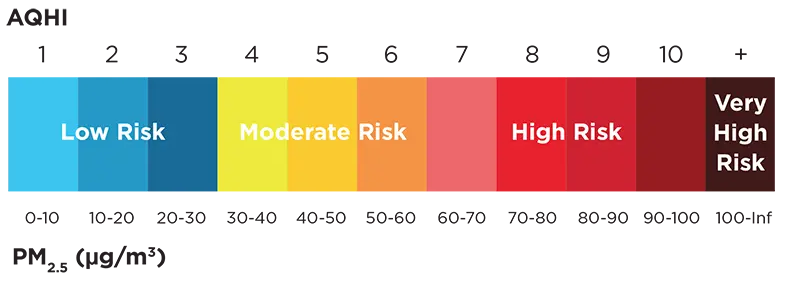
LittleLungsAB reports the AQHI from Continuous Air Quality Monitoring Stations and the PM2.5 concentration from Purple Air microsensors, both on the AQHI scale. Stations are updated approximately hourly; microsensors are updated every 30 minutes.
Inputting your location provides the AQHI/PM2.5 concentration from the three closest stations and microsensors. It is important to consider more than one microsensor as an individual sensor may give anomalous readings based on local influences (such as nearby campfires), or could be malfunctioning or offline.
We recommend following the guidelines for the highest AQHI/concentration reported nearby. Check the air quality before outdoor play, and periodically throughout the day (e.g. every hour while outside).
It is important to note that an AQHI of 7 (PM2.5 concentration of 60 µg/m3) and above is considered to be high risk for the general population. At-risk groups, consisting of infants and children, the elderly, pregnant people and those with pre-existing conditions, are at greater risk at lower levels.
According to the Canadian AQHI recommendations, infants and children should “consider reducing or rescheduling strenuous outdoor activities” at a moderate health risk AQHI value of 4-6. For young children, this includes typical outdoor play. Children with underlying diseases, such as asthma, should not play outdoors at or above a value of 5. Not just high-risk days are concerning; prolonged (many-days) exposure to moderate air quality can damage developing lungs.
Even if it is deemed safe to play outdoors, it is crucial to monitor symptoms, as air quality conditions can be very localized and personal responses are unique. More details on signs and symptoms can be found at www.albertahealthservices.ca/news/air.aspx and in the recommendations at littlelungs.ca/recommendations.
Read more about this project in the University of Alberta Folio:
https://www.ualberta.ca/en/folio/2024/06/u-of-a-project-could-help-children-in-daycare-breathe-easier.htmlWatch the Alberta Capital Airshed Webinar on these recommendation here:
https://capitalairshed.ca/clean-air-webinar-protecting-little-lungs-outdoor-air-quality-and-childrens-health/
This dashboard was designed and developed by the University of Alberta, Faculty of Engineering. We acknowledge contributions from the Alberta Capital Airshed, the Alberta Airsheds Council, the University of Alberta Faculty of Medicine & Dentistry, the University Infant Toddler Center (UITC), and the Tomorrow Foundation. A version of this dashboard has been in use by the UITC since Spring 2024.